
Celebrating Epiphany
La Fête des Rois or Dia de Los Reyes is a interesting tradition to share with children and a great opportunity to link language a culture. Celebrated on the 6th January, Epiphany is a key festival in the Christian calendar and marks the visit of the three kings to the baby Jesus. With lots of regional variations, as well as diverse ways of marking the celebration in different parts of the French and Spanish-speaking worlds, there is lots of scope to explore this tradition in fun and creative ways.
In Spain, Dia de Los Reyes, is the day that children traditionally receive their presents. On the evening of the 5th January, the three kings arrive in towns and cities across the country, bearing gifts. Arriving by float, horse, boat, train or on foot (depending on the region) they process through the streets, throwing out their treats of sweets and chocolates to the crowds lining the streets. Music and performers accompany their progress. The festivities may extend well into the night – at least for the grownups – with street parties and markets. This clip from the Cabalgata de los Reyes Magos in Madrid, shows the arrival of the kings along with other street performers and, of course, the spectacular fireworks which mark the occasion. Another nice resource is this clip from the BBC, which explores – in both Spanish and English – the Epiphany traditions of Spain through a conversation between Ashleigh and her Spanish friend Cristina, along with more footage from the cabalgata.
The day of Epiphany itself is generally a quieter occasion, with children opening their presents at home and families sharing a roscón de reyes (tortell de reis in Catalan), a brioche-style cake shaped like a crown and studded with candied fruit to represent jewels. Much like the tradition of hiding coins in the Christmas pudding, a porcelain figure of the baby Jesus or one of the wise men is often hidden inside. If you find it, you get to wear the crown, usually provided with shop-bought versions. A dried fava bean is also sometimes hidden somewhere in the cake but if you find it, it’s your job to make (or pay for) the roscón next year. Recipes, like this one, are easily found online. Although time would probably prevent you from making a full roscón with your pupils, it might be fun to make one at home to share with the children. The king cake is often served with a delicious hot chocolate.

France is a country of two halves when it comes to the cake eaten to celebrate Epiphany or La Fête des Rois, as illustrated by this helpful little map. In the north, a galette des rois – a puff pastry confection filled with frangipane – is commonly found. Further south, the gâteau des rois – made from brioche dough – bears a close resemblance to the king cake eaten in Spain. Both sweet treats have a figurine, know a fève, which is hidden inside during the baking process, and whoever finds it, gets to be king or queen for the rest of the day. BBC Bitesize has this handy clip which also introduces some of the vocabulary associated with the celebration, as well as explaining the tradition of the youngest member of the family hiding under the table to decide which piece of the cake goes to whom.
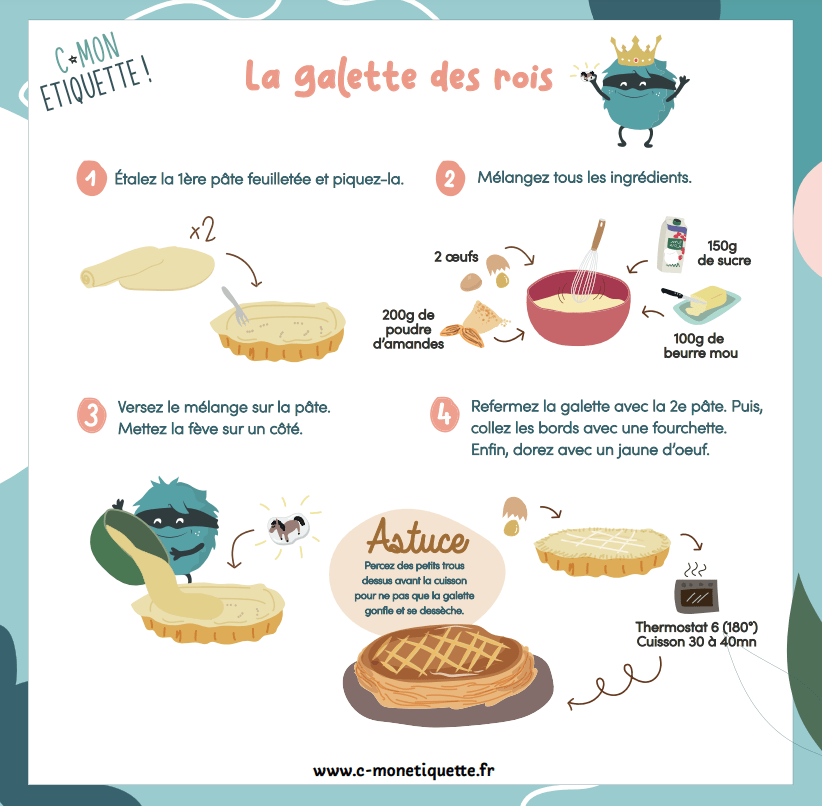
I like the children to learn some key vocabulary associated with the celebration and use this pairs game, which they always enjoy. Even Year 6, who are in their fourth year of celebrating La Fête des Rois always need a reminder of the key words and enjoy the competitive element. The little recipe card below is also a nice visual guide for making a galette des rois and could be used as a reading activity or printed off for home learning. I often make several galettes in the first week back after Christmas and bring them into school to share with the children, substituting frangipane for stewed apples to avoid nut allergy issues.
I really love teaching the children this song about la galette des rois, which is simple and repetitive enough to do in one lesson. I’ve sometimes used the lyrics first with older pupils, allowing them to read the text and see how much they can understand before learning to sing the song together. I also incorporate the music into a pass the parcel-type activity, with a “galette” made with this template. The “slices” of galette are placed into a drawstring bag and passed around the circle (either the whole class or smaller groups) as the music is played and we sing together. At random intervals, the music is stopped and the child holding the bag pulls out a “slice”. They check their segment for the crown, which represents la fève and tell the group if they have it (oui/je suis le roi/je suis la reine/j’ai la fève) or they haven’t (non/je ne suis pas le roi/je ne suis pas la reine/je n’ai pas de fève). Any pieces without the fève go back into the bag until the piece with the crown is finally pulled out. Responses can be differentiated, as above, according to the needs of the class or the age of the pupils. I created a Spanish version of the game, with a roscón outline, for my Spanish Club and we use this little song as the backing music.
There are some great, and fairly simple, French books available that could be shared with pupils to mark the occasion. L’âne Trotro: le roi de la galette, along with T’choupi aime la galette (this short episode of the T’choupi TV series also focuses on the celebration of La Fête des Rois) and, my favourite: Roule galette. Similar in plot to the gingerbread man, it offers a wonderful opportunity to draw comparisons between traditional tales from different countries and, although the text is fairly complex, it is nice and repetitive. The children enjoy joining in with the “attrape-moi, si tu peut !” line, which comes up several times. As well as the T’choupi clip mentioned above, this episode of the classic Petit Ours Brun follows Little Bear as he celebrates and might be a nice watch to end a lesson.
Festivals such as Epiphany are an excellent opportunity to explore with children the reasons why traditions originating in Europe are now celebrated with similar customs in other parts of the world. In Puerto Rico, for example, children place shoe boxes full of grass or straw under their beds (rather than shoes, as per the Spanish tradition) to feed the camels bearing the wise men. The magi will then take the grass to feed their horses or camels and leave gifts under the bed as a reward. Lin-Manuel Miranda, who children may know as the writer behind the songs in the film Encanto, talks more about his own reyes traditions in this short clip.
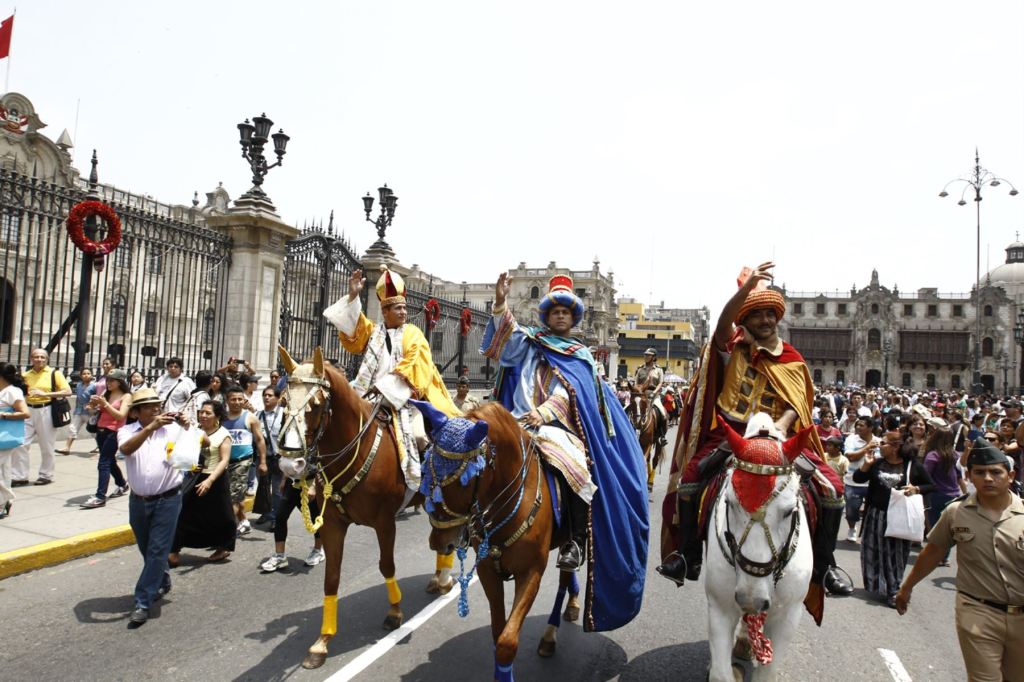
In Peru, the Bajada de Reyes is a parade of the wise men and celebrations marking the taking down of public (and private) nativity scenes. The festivities also involve children taking their dolls, symbols of the baby Jesus, to church to be blessed. This clip shows the Bajada de Reyes in Lima and would make a great stimulus for discussion when compared to images and clips of similar celebrations in Spain.
On the French island of Guadeloupe, unlike in many parts of the world, Epiphany doesn’t mean the last day of Christmas celebrations, but rather the start of a new period of celebration: Kannaval (Carnival). This lasts until the start of Lent and ends with the burning of the Carnival King, Vaval. For more ideas and inspiration for celebrating carnival, see my my very first blog post from back in 2021.
Joyeuse Epiphanie ! Felices reyes magos!
 My Primary Languages Classroom
I love teaching this aspect of French culture too! I am lucky enough to have a kitchenette so I have baked galettes (with jelly-baby added to avoid broken teeth!) but this paper version looks like a great way too, avoiding possibility of allergic reactions… Thankyou!
LikeLike